


The short answer
Test feed placement for a clear product or problem introduction and conversation placement for an offer addressing a specific question. Compare feed-only and conversation-only delivery with the same offer, audience and creative, then give more budget to the placement producing qualified outcomes at an acceptable cost.
Would your ad work better between posts or beside a discussion? The answer starts with what you need someone to understand before they click.
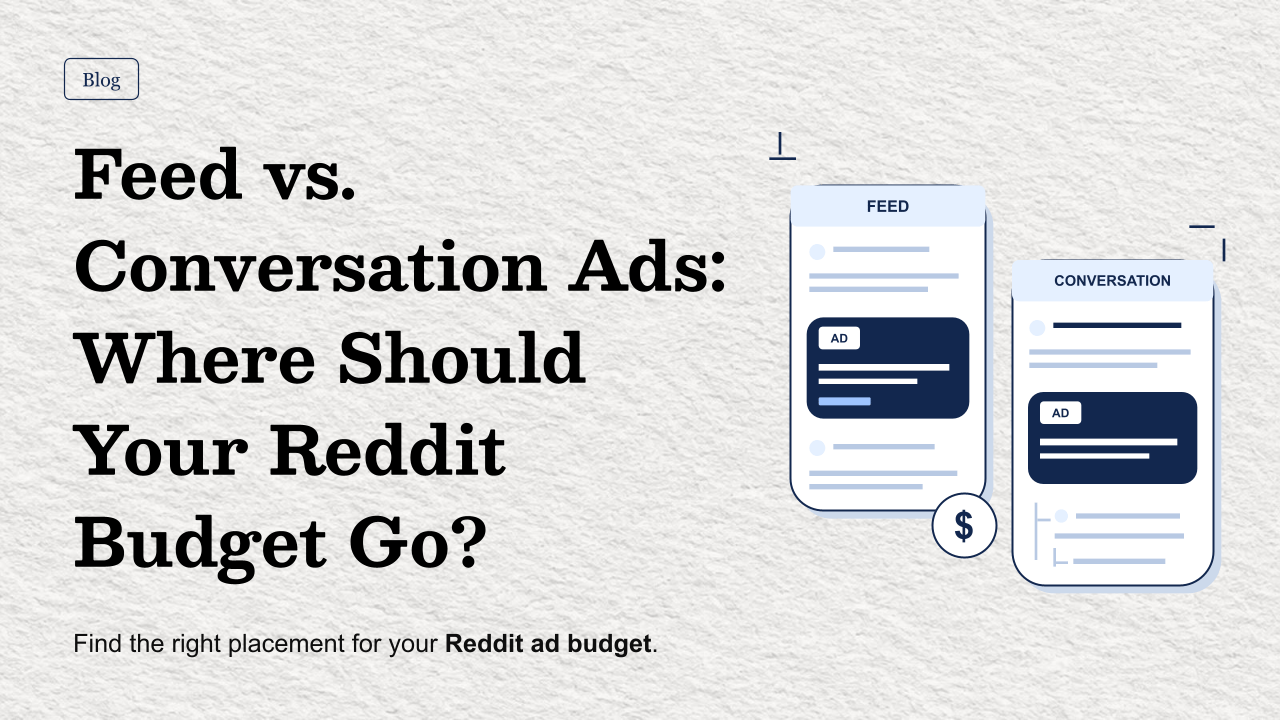
Feed ads meet people as they browse Reddit. Conversation ads meet them on a discussion page, where their attention may already be on a specific question. That changes how your offer competes for attention, but it does not make either audience automatically more likely to buy.
The right starting point depends on your offer. Compare the settings, choose a test, and judge the customers each placement brings in.
Feed vs. Conversation: Which Should You Test?
Feed placement puts your ad among posts in the Home, Popular, and Community feeds. Consider it when you need to introduce a product, demonstrate a problem, or make a benefit easy to grasp while someone scrolls. The creative must establish relevance quickly; a reader should understand who the product helps without opening a discussion first.
Conversation placement puts your ad on a comment page, either between the original post and first comment or deeper among replies. Consider it when your offer is a useful next step for someone investigating a problem: a migration checklist, comparison guide, or specific demonstration. Reddit's Standard campaign guidance explains the placement controls and notes that availability varies by objective.
The practical distinction is the attention you are competing for: feed ads compete with the next post, while conversation ads compete with the discussion someone came to read. Placement controls where the ad appears; targeting determines who is eligible to see it. Our advertising setup guide covers those separate setup decisions.
A discussion reader could be troubleshooting, researching for someone else, or browsing casually. Test the opportunity without treating the setting as proof of buying intent.
Make the Offer Clear in Either Setting
Consider a fictional SaaS product that helps teams migrate data. Its offer is a walkthrough showing what transfers, what needs preparation, and where manual checks remain necessary.
A feed execution could lead with the recognizable problem: “Switching tools? Check what happens to permissions before you migrate.” A conversation execution might emphasize the practical resource: “A migration checklist covering permissions, attachments, and the checks to run before switching.”
Both examples describe the same offer and can stand alone. Avoid “Here is the answer” or “We can fix this” when the surrounding thread may concern something else. Your creative needs to explain the problem without relying on a particular nearby comment.
Preview the ad in the placements your setup supports, checking legibility, cropping, and the destination promise. Our Reddit ad examples provide execution references, but the information a prospective customer needs should determine the message.
For the first placement comparison, use the same creative in both settings. Then adapt the message in a follow-up test. Our creative-testing guide explains how to evaluate those changes separately.
Compare Feed-Only With Conversation-Only
To decide which placement deserves more budget, compare one feed-only ad group with one conversation-only ad group over the same dates. Use a setup that lets you select each separately, then verify delivery in reporting. Give them comparable spending limits so an automatic allocation does not leave one with too little delivery to assess.
Reddit reported 12% lower costs for combined feed-and-conversation delivery versus feed-only advertisers in its March 2025 announcement, citing May 2024 internal data. That supports investigating combined delivery, but it does not compare the two placements separately or identify the cost metric. It cannot tell you which will produce cheaper qualified leads.
Keep the offer, audience, creative, landing page, campaign objective, conversion event, and attribution settings consistent. If one feed promotes a demo while another promotes a checklist, you are comparing two offers as well as two placements. Adapt the message after this first comparison, or label the exercise as a comparison of complete campaign approaches.
Before launch, define a qualified inquiry, a spend ceiling for each placement, and a review date that allows time for qualification. Record targeting expansion and bidding settings, and check whether campaign budget optimization will distribute spend unevenly. If your budget cannot support both groups, avoid declaring a winner from a few clicks.
Complete both placement columns before launch. Afterward, add spend, inquiries, qualified inquiries, and cost per qualified inquiry for each, using the same follow-up period.
Record before launch | Feed placement | Conversation placement |
|---|---|---|
Offer, audience and destination | Same agreed settings | Same agreed settings |
Objective, event and attribution | Record selections | Match selections |
Delivery and expansion controls | Verify feed-only; record controls | Verify conversation-only; record controls |
Spend ceiling and review date | Set before launch | Set before launch |
Qualification and outcome window | Define suitable inquiry and follow-up time | Use the same definition and time |
Separate ad groups provide a practical comparison, although overlapping audiences and differences in delivery prevent treating it as a randomized experiment. Use the results to guide your next budget decision and check whether they hold when spending changes.
Move Budget Toward Qualified Outcomes
Suppose each placement spends $240. Feed generates 12 inquiries and conversation placement generates eight. Feed appears cheaper at $20 per inquiry versus $30, but qualification changes the picture.
If three feed inquiries and four conversation inquiries meet the team's agreed criteria, the spend per qualified inquiry is $80 and $60, respectively. These figures are illustrative, not client results. They show why choosing the lower submission cost can produce a different decision from choosing the lower qualified-inquiry cost.
In that example, conversation placement deserves the next controlled budget increase because it produces more qualified inquiries for the same spend. Feed deserves more budget if the pattern reverses. Judge both after the same follow-up period; three or four qualified inquiries remain an early signal, so do not move the entire budget on that evidence.
Track accepted opportunities and customers when the sales cycle allows. Our Reddit attribution guide explains how to connect those outcomes without treating every attributed conversion as an additional sale caused by the campaign.
If feed produces cheaper clicks but weaker leads, keep its budget steady while reviewing the promise attracting those visitors. If conversation produces qualified leads but little volume, increase spend gradually and watch whether quality holds. When neither attracts suitable buyers, revisit the offer and audience before expanding either placement.
Use feed to test whether your introduction earns attention, and conversation placement to test whether your offer earns a place beside a discussion. Let comparable qualified outcomes decide where the next dollar goes.
Common questions
Are Reddit conversation ads the same as comments on an ad?
No. Conversation placement describes where an advertisement appears on a discussion page. Enabling comments controls whether people can reply to the advertiser's own post.
Does Reddit's 12% cost claim mean conversation ads are always cheaper?
No. The March 2025 announcement compared combined feed-and-conversation delivery with feed-only advertisers, citing internal May 2024 data. It does not specify the cost metric or establish a universal result for conversation-only campaigns.
What should a placement comparison keep consistent?
Use a comparable offer, audience, creative, destination, objective, optimization event, attribution settings and qualification window. Record expansion and budget-allocation settings, and recognize that separate ad groups are not automatically a randomized test.
How we research, write and correct these posts is in our editorial policy.

